
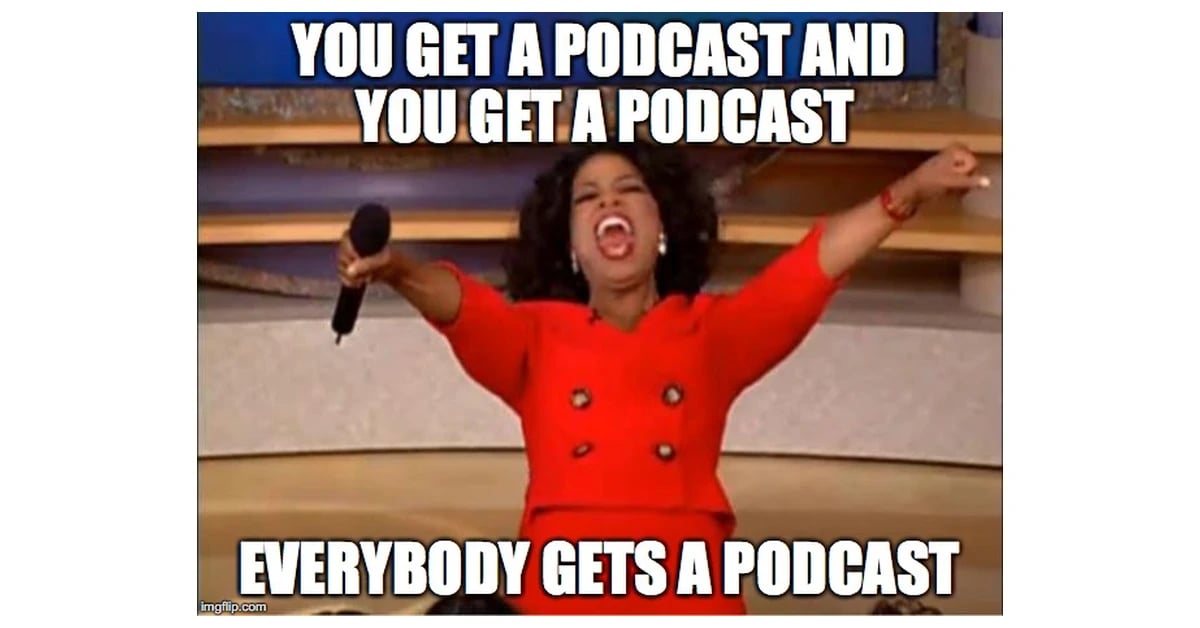
Let's be honest: the world doesn't need another podcast. Especially at a time when attention is the scarcest commodity on the planet. We live in a time when attention is extremely scarce, there's an oversaturation and overproduction of content. You really need to be interesting, entertaining, and educational to cut through. AI is not going to solve this. You have to have a view.
Most people think a podcast is about crazy amounts of listenership. But the reality is it can be used as an effective sales tool even without massive download numbers.
I've watched this play out with several B2B companies in the past three years. They didn't launch a podcast to become the next Serial or Acquired. They launched it because it was a vehicle to reach a specific audience, build credibility, and turn listeners into customers. Here's what I've learned about how B2B content, specifically podcasts and similar formats, actually drives acquisition.
The Podcast-as-Funnel Model
Most B2B companies think of content as top-of-funnel awareness. Write a blog post, get traffic, hope someone buys. That's one approach.
The companies that win with podcasts think about it differently. They see the podcast as the entire funnel.
Episode one: Introduce the problem. Establish credibility. Get the listener's attention.
Episodes two through six: Go deeper. Showcase expertise. Build trust.
Episode seven onwards: You're not selling, but you're positioned as the authority who has solved this problem. When someone who's been listening for eight weeks has a need, you're the obvious choice.
The listener doesn't need to be converted from cold traffic. They've already spent six hours with your voice in their ear. They know how you think. They've heard your frameworks multiple times. They trust you.
What Makes Content-Led Acquisition Work
Most companies start and then give up too early. The companies I've worked with that saw content drive actual pipeline had a few things in common:
• A specific take: They didn't just explain what their product did. They had a perspective on their industry. They took positions that some people disagreed with. That generated discussion.
• Clear audience: They knew exactly who they were making content for. Not 'everyone interested in marketing' but 'VP of marketing at B2B SaaS companies with product-led growth models.'
• Consistency: They published regularly. Every two weeks. Every week. Not sporadic content that stops after three months.
• Distribution: They didn't just publish and hope. They promoted episodes in communities their audience frequented. They emailed their list. They shared to relevant channels.
The Real Timeline
Here's where most companies get it wrong. They expect results in three months. Thirty days in, they're not seeing pipeline. They kill the project. Most companies start and then give up too early.
The important thing is you really need to have buy-in at the executive level and patient investors in the programme. All too often, keep-or-kill conversations tend to happen at the one-year mark, just before the programme is about to take off. And don't forget: you need to invest in distribution as well as content.
Based on what I've observed, here's a realistic timeline:
• Months 1-3: Audience building. You're getting 30-300 listens per episode. You're starting to appear in search. You're starting to notice repeat listeners.
• Months 4-6: Growth. Listener numbers are climbing. You're getting inbound inquiries from listeners. Some of them are warm.
• Months 7-12: Impact. Content is driving meaningful pipeline. You're getting inbound that says 'I've been listening to your podcast for six months.' Your sales team is closing deals with people who found you through content.
• Month 12+: Compound growth. Early listeners are advocates. They're referring others. Content backlog is working for you. Each new episode gets shared by previous listeners.
Most companies that quit are quitting at month three or month four. Right before the programme is actually starting to work.
Podcast vs Blog vs LinkedIn vs Other Formats
Podcast is one format. It works well for certain audiences and certain types of content. But it's not the only way.
A B2B SaaS company targeting product managers might get better results with a weekly essay on LinkedIn. A fintech company might get better results with a research publication and a weekly Substack. A B2B services company might get better results with video interviews on YouTube.
The principle is the same. Pick a format that allows for depth. Pick an audience. Build consistently. Own the distribution.
The advantage of a podcast is that it's intimate. People listen while commuting, exercising, doing chores. They hear your voice. It builds connection.
The disadvantage is that it's harder to search for. If someone doesn't know about your podcast, they won't stumble across episode 47. You have to drive discovery.
Other formats have different trade-offs. LinkedIn is searchable but noisy. Substack is ownable but requires readers to opt in. YouTube is discoverable but takes more production.
How to Measure If It's Working
Don't measure a content-led acquisition programme on audience size. Measure it on:
• Inbound inquiries with content attribution: How many people are saying 'I found you through your podcast' or 'I've been reading your content'?
• Sales cycle length: Do deals close faster when the prospect came through content? Most companies find these deals close 30-40 per cent faster because trust is already established.
• Deal quality: Are these good-fit customers? Do they have lower churn? Do they spend more? Content-sourced customers often have better LTV.
• Referrals: Are your customers referring others because they listen to your content or read what you write?
Start measuring these at month one. You won't see much. But track them over 12 months. If all four metrics are moving, the content programme is working.
The Real Lesson
Content-led acquisition works, but not the way most companies think. It's not about virality or massive audiences. It's about building a small, deeply engaged audience that trusts you and becomes your customers and advocates.
It takes time. It requires consistency. It requires distribution. And it requires patience at the executive level.
But for B2B companies, especially those selling high-ticket products or long-term relationships, content-led acquisition often delivers better results and better customers than paid acquisition.
Start with one specific audience, one clear take, one consistent format. Commit to 12 months. Measure inbound quality, not vanity metrics. Then scale.